How a foreigner buys property in Marrakech: title, notary, taxes and transfers
By Brando Monetti, Co-founder, partnerships. Edited by Selma Setta. Published 26 October 2026, updated 9 November 2026. Figures checked 9 November 2026.
A foreigner can buy a titled urban home in Marrakech without prior authorisation; agricultural land is the exception. Budget 4% registration duty, a 1.5% land-registry fee and the notary's regulated fee. Capital gains are taxed at 20% with a 3% minimum, rents at 10% or 15%. Pay in foreign currency through a Moroccan bank so proceeds can later leave.
| Registration duty | 4% of the price for residential, commercial or professional premises (DGI) |
|---|---|
| Land-registry mutation fee | 1.5% ad valorem plus a MAD 100 fixed fee per property (ANCFCC, Decree 2.16.375) |
| Capital gains tax | 20% of the net gain, minimum 3% of the sale price (DGI) |
| Rental income tax | 10% below MAD 120,000 gross, 15% at or above; gross rents up to MAD 30,000 a year exempt (DGI) |
| Agricultural land | Non-Moroccans need an attestation de vocation non agricole outside the urban perimeter (government reminder, April 2022) |
| Marrakech market 2025 | Prices up 1%, transactions up 24.1% (Bank Al-Maghrib and ANCFCC index) |
| Transfer of proceeds | Allowed when the purchase was financed in foreign currency (IGOC 2026, article 171) |
What can a foreigner own in Marrakech, and what is off limits?
A non-Moroccan can buy a flat, a villa or a riad inside the urban perimeter without prior authorisation, and nationality does not change the taxes at purchase. The restriction is agricultural land.
In April 2022 the government reminded local administrations of the rules. As reported by Bladi on 30 April 2022, a foreign buyer must hold an attestation de vocation non agricole to acquire land “situés en dehors du périmètre urbain”; the certificate requires a non-agricultural investment project on a matching area, and must not be issued for “zones à grand potentiel agricole”.
For Marrakech this matters outside the ring road: the Palmeraie, the Route de Fès, the Route de l’Ourika and the Agafay side mix urban, peri-urban and agricultural zoning, and a villa plot that looks residential can sit on agricultural land. A notary checks the zoning certificate before you commit.
Titre foncier or melkia: which title am I buying?
Morocco runs two systems side by side, and the gap between them is the biggest risk for an overseas buyer.
A titre foncier is the registered title. As a 2026 LesMRE guide puts it, “Le titre foncier est un document délivré par l’ANCFCC après procédure d’immatriculation”, under “le dahir du 12 août 1913”. The Agence Nationale de la Conservation Foncière, du Cadastre et de la Cartographie (ANCFCC) records every sale, gift, inheritance and mortgage against the title number.
A melkia (moulkia) is older. “La Moulkia est un acte de propriété établi par deux adouls (notaires de droit coranique) selon la procédure du tawthiq.” It rests on testimony, not on a central register. The same guide spells out the consequences: “Elle ne garantit pas qu’une autre Moulkia n’existe pas pour le même bien” and “elle ne prouve pas l’absence d’hypothèques ou de droits de tiers”. A bank will not lend against it, and in a dispute with a titleholder the melkia is the weaker document.
Many medina riads are still held under melkia; new builds in Guéliz, Hivernage and the Palmeraie almost always come with a titre foncier or a titre parcellaire carved out of the developer’s mother title. Buying a melkia property is possible, but Moroccan notaries usually advise running the immatriculation procedure so the property ends up titled; the ANCFCC sets the timetable case by case.
How does the notary process work?

Property sales in Morocco go through a notary (notaire), who drafts the deed, holds the funds, checks the title and zoning, collects the taxes and files the deed. The usual sequence:
- Compromis de vente with a deposit held by the notary, not paid to the seller.
- Due diligence: a current certificat de propriété from the ANCFCC, the zoning certificate where relevant, tax clearance, and for a riad the permits for any works.
- Acte de vente signed before the notary, with full payment through the notary’s account.
- Registration with the tax administration and inscription of the transfer on the titre foncier at the ANCFCC.
The notary’s fee is regulated: Article 15 of Law 32-09 entitles the notary to fees “dont le montant et les modalités de perception sont fixés par voie réglementaire”, and a capped scale was the subject of a Conseil de la concurrence opinion in the Bulletin officiel of 13 February 2020. Ask for the written quote, including VAT, before you sign the compromis.
What taxes and fees do I pay when I buy?
| Cost item | Rate or amount | Source |
|---|---|---|
| Droits d’enregistrement (registration duty) | 4% of the price for residential, commercial, professional or administrative premises; the land under them up to five times the covered area | DGI, Guide fiscal 2024 |
| Registration duty, first sale of social housing | 3% | DGI |
| ANCFCC droit de mutation (recording the transfer on the title) | 1.5% ad valorem plus a MAD 100 fixed fee per property | ANCFCC tariff, Decree 2.16.375 |
| ANCFCC mortgage inscription | 1.5% from MAD 250,001 to 5,000,000; 0.5% above | ANCFCC tariff |
| Notary fee | Regulated scale under Law 32-09, plus VAT; quoted by the notary | Law 32-09, art. 15 |
The Direction Générale des Impôts states the headline duty plainly in its 2024 guide: a buyer of residential, commercial, professional or administrative premises is “soumis aux droits d’enregistrement au taux réduit de 4%”. The ANCFCC tariff under Decree 2.16.375 of 18 July 2016 lists the “Droit de mutation” at 1,5 % with a “Droit fixe (par propriété)” of 100 dhs; its formalities leaflet gives two days for a total transfer, to the issue of the new certificat de propriété.
On a melkia purchase the ANCFCC side is different: you pay for the immatriculation procedure itself, including the droit de publicité and the fee for establishing the new title, rather than a simple mutation.
How are capital gains and rental income taxed?
Capital gains (profits fonciers). The DGI guide sets the rate at 20% of the net profit, with “un minimum d’imposition même en l’absence de profit, qui ne peut être inférieur à 3% du prix de cession”. Net profit is the sale price less selling costs, minus the purchase price plus acquisition costs and documented works. Two exemptions matter: sales totalling no more than MAD 140,000 in a calendar year, and a main residence occupied for at least five years. In practice the notary withholds and pays the tax from the proceeds.
Rental income (revenus fonciers). Gross rents are taxed at 10% when annual taxable gross rents are below MAD 120,000, and 15% at or above that level; annual gross rental income that does not exceed MAD 30,000 is exempt, and that exemption cannot be combined with the threshold for other income. The annual return is due before 1 March of the following year; a tax adviser in both countries should confirm treaty treatment. Local taxes (taxe d’habitation and taxe de services communaux) also apply to non-resident owners; their rates were not in the sources we checked, so ask the notary for your district’s figures.
How do I get my money out when I sell?
This is decided on the day you buy. Morocco’s foreign-exchange rules, consolidated in the Instruction Générale des Opérations de Change (IGOC) 2026, treat property bought by a foreign national as a foreign investment: article 170 covers foreign individuals “whether resident or non-resident in Morocco”, and article 173 requires financing in foreign currency, by direct transfer from abroad or a debit from “un compte en devises ou en dirhams convertibles”.
If that condition is met, article 171 applies. In LesMRE’s September 2026 summary, it “garantit le transfert des revenus d’un investissement ainsi que du produit de sa cession”, meaning rents and sale proceeds, “à condition que celui-ci ait été financé en devises”. Upsilon Consulting’s reading of the same text is that the seller may transfer “le produit net (plus-value incluse)” after Moroccan taxes are paid, with the bank checking the original payment proofs.
If the property was paid for in ordinary dirhams, a non-resident’s proceeds go instead into a compte convertible à terme, transferable “en quatre fractions égales de 25 %”, one tranche a year. That option is not open to foreigners resident in Morocco.
Practical steps: transfer the price from your own foreign account to the notary’s or your own Moroccan bank account, keep the SWIFT confirmations and the bank’s attestation of the inflow, and make sure the deed records that the price was paid in foreign currency. Your bank’s compliance desk can confirm the article numbers against the current instruction.
What are prices doing in Marrakech?
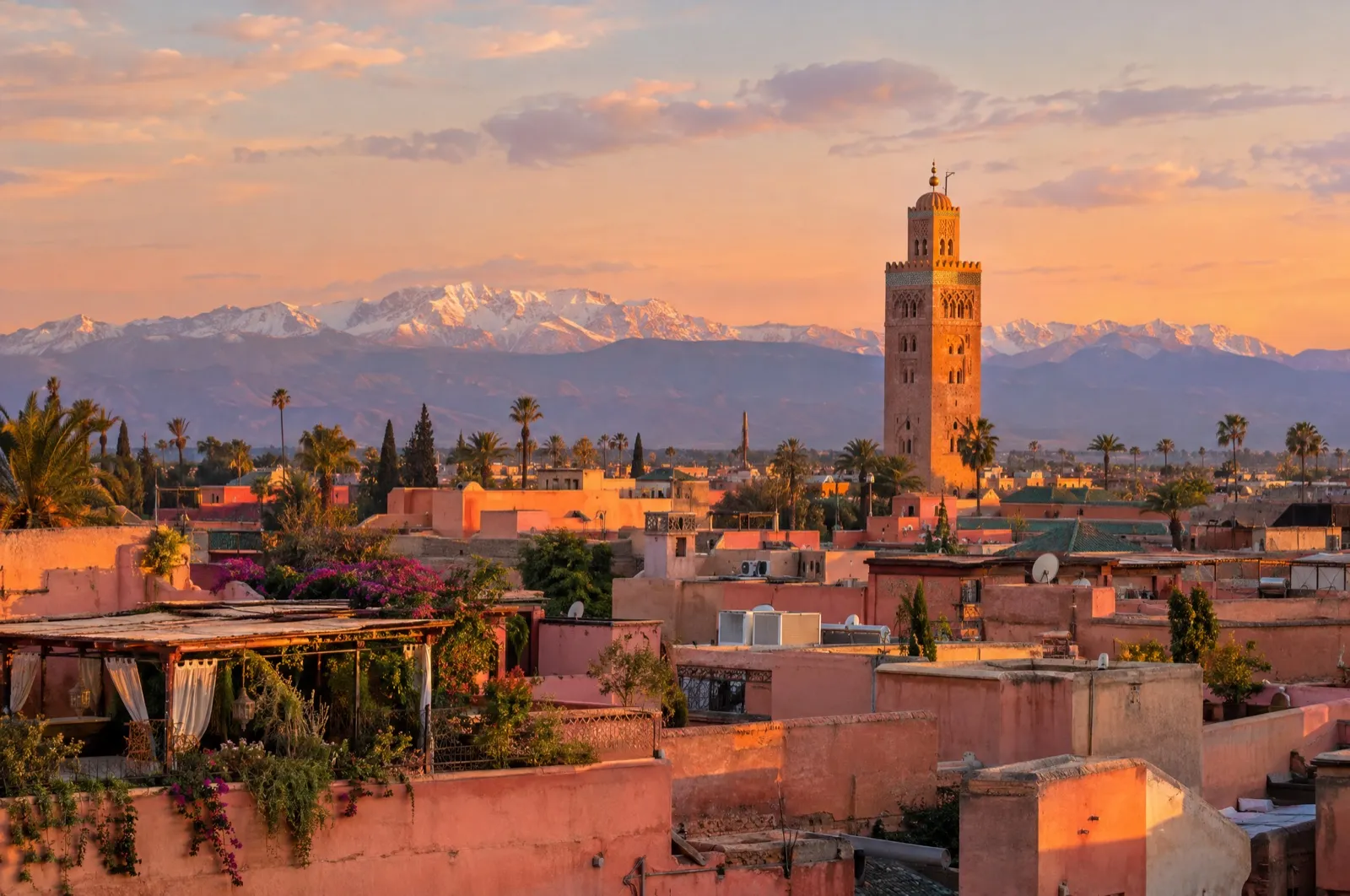
Two published series cover the city.
The Bank Al-Maghrib and ANCFCC property price index (IPAI) for 2025, reported by Finances News Hebdo on 4 March 2026: “L’indice des prix des actifs immobiliers (IPAI) a enregistré, en 2025, une hausse de 0,6%” nationally, with residential up 0.8%, land up 0.4% and professional premises up 0.3%, and transactions up 3.1%. For Marrakech the index shows prices up 1% and transactions up 24.1%, the strongest volume growth of the four cities reported (Rabat +15%, Casablanca +7.8%, Tangier +3.3%).
The latest quarterly bulletin we could read, Bank Al-Maghrib and ANCFCC note N° 67 for the second quarter of 2026, shows Marrakech prices up 0.5% on the previous quarter, with residential up 1.1%, and sales up 18.3% quarter on quarter. Nationally the index rose 0.7% on the quarter and 0.7% on a year earlier.
Mubawab’s 2025 review, reported by Consonews on 28 January 2026, puts the national average asking price at MAD 14,042 per m² for apartments and MAD 14,602 per m² for villas, ranks Marrakech with Rabat and Casablanca as the dearest apartment markets, and records a fall in Marrakech rental demand in 2025 (apartments down 11.85%, villas down 5.41%). These are listing averages, not transaction prices, and a Marrakech-specific per-metre figure was not in a source we could read, so ask a licensed agent for comparable sales in the exact street.
Riad or new build: what changes in the paperwork?
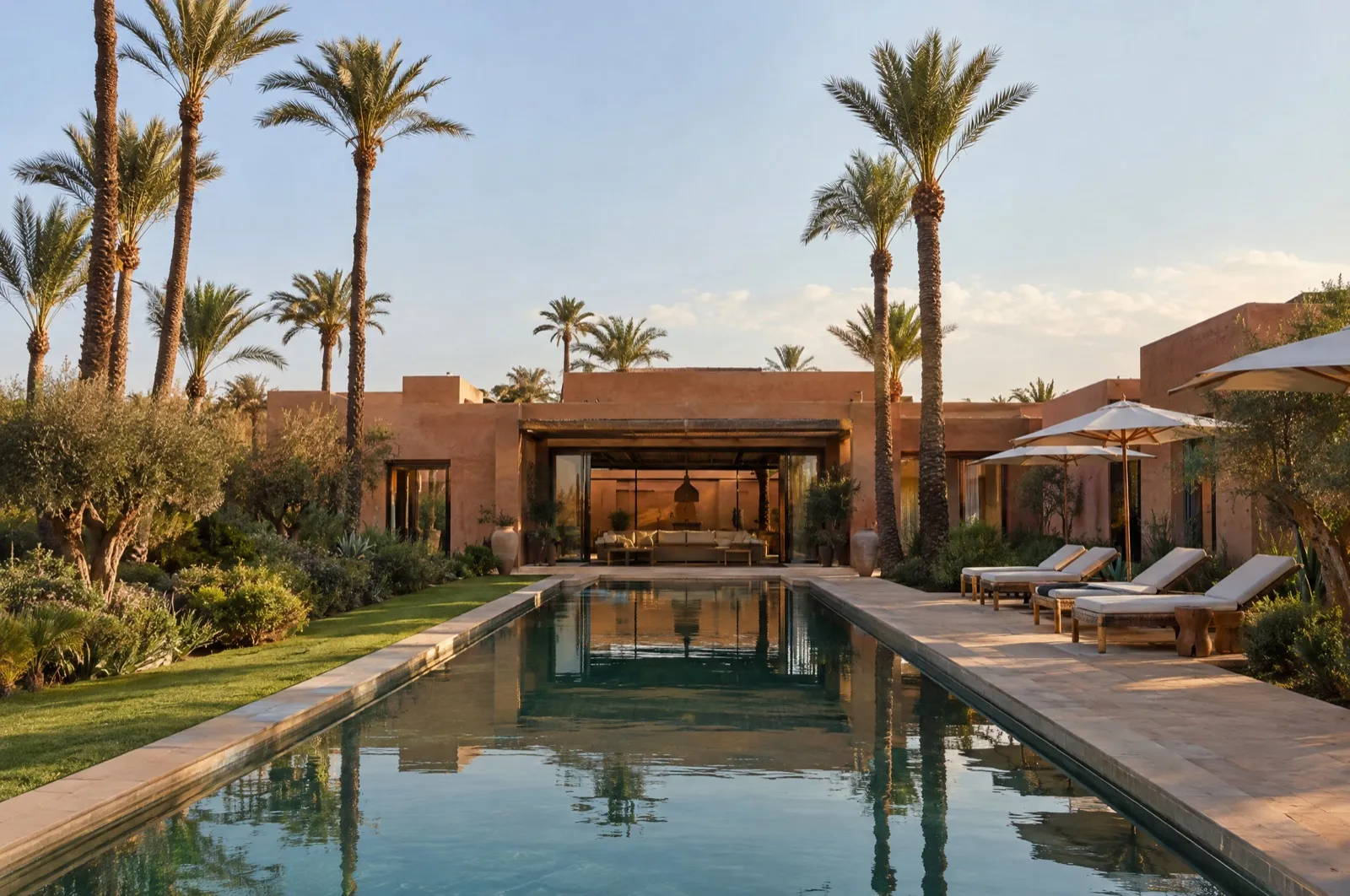
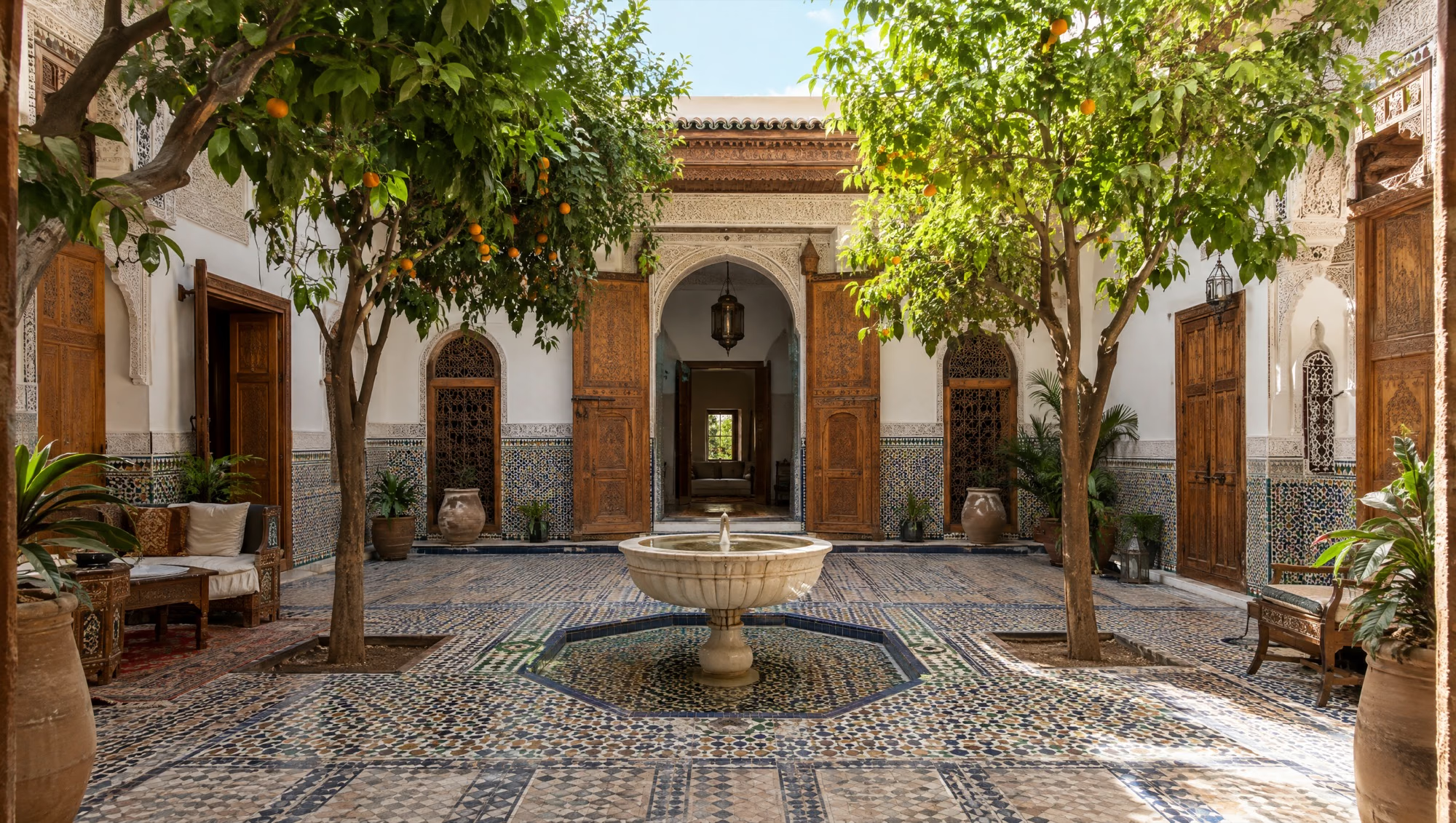
A riad is usually a renovated medina courtyard house, often on a melkia, often with unpermitted works, and frequently run as a guesthouse. The checks are title, the authorisation for any tourist use, and the permits for structural changes. A new build typically comes with a titre parcellaire, a staged payment contract for off-plan units and defined service charges; the checks are the developer’s title, the building permit and the certificate of conformity at handover. The 4% duty and 1.5% mutation fee apply in both cases.
What changes next
- IGOC 2026: the current foreign-exchange instruction took effect in 2026 and practitioners report new flexibilities for long-term resident foreigners. Transfers still turn on proof of foreign-currency financing.
- Notary fee scale: the decree under Law 32-09 remained contested after the 2020 Conseil de la concurrence opinion. Check the quote rather than an online percentage.
- IPAI, 9 November 2026: the second-quarter 2026 bulletin (N° 67) is out: Marrakech prices up 0.5% and sales up 18.3% on the previous quarter. The third-quarter 2026 bulletin is the next reading to watch.
How we checked this
Re-checked on 9 November 2026 against every source listed. Tax rates are quoted from the Direction Générale des Impôts’ 2024 guide for Moroccans resident abroad, and land-registry fees and the two-day transfer time from the ANCFCC’s tariff under Decree 2.16.375 and its formalities leaflet; all three PDFs were downloaded and read in full that day. The agricultural-land rule is the April 2022 government reminder as reported by Bladi; prices are the Bank Al-Maghrib and ANCFCC index via Finances News Hebdo (4 March 2026) and the official second-quarter 2026 bulletin (N° 67), and Mubawab via Consonews (28 January 2026). Office des Changes provisions are quoted from Upsilon Consulting (3 June 2026, reviewed 5 November 2026) and LesMRE (22 September 2026); we did not read the IGOC 2026 text on the Office des Changes site itself. The only correction on this pass was the wording of the MAD 30,000 rental exemption, which the DGI guide frames as income not exceeding that amount.
Questions people ask
Can a foreigner own a riad in the Marrakech medina?
Yes. A built property inside the urban perimeter can be bought by a non-Moroccan without prior authorisation. The real question is the title: many medina riads are still held under a melkia (adoulaire deed) rather than a titre foncier, and a notary will usually advise registering the property with the ANCFCC before or at purchase. Agricultural land outside the city is the restricted category.
What is the difference between a titre foncier and a melkia?
A titre foncier is issued by the ANCFCC after the immatriculation procedure under the dahir of 12 August 1913; every later sale, mortgage or inheritance is recorded on it. A melkia (moulkia) is a deed drawn up by two adouls on witness testimony. It is not in the national register, so it cannot prove that no other deed or mortgage exists for the same property.
How much are the taxes and fees when I buy?
Registration duty is 4% of the price for residential or commercial premises under the Moroccan tax code, and the ANCFCC charges a 1.5% mutation fee plus MAD 100 fixed per property to record the transfer on the title. The notary's fee is set by regulation under Law 32-09 and is quoted separately with VAT. Allow roughly 6% plus the notary's fee as a working total.
How is a later sale taxed?
Profit on the sale of a building or land is taxed at 20% of the net gain, with a minimum of 3% of the sale price even when there is no gain. Sales totalling no more than MAD 140,000 in a calendar year are exempt, and an owner-occupied main residence held at least five years can qualify for exemption. A notary files the declaration and the tax is cleared before proceeds are released.
Can I take the money out of Morocco when I sell?
The 2026 foreign-exchange instruction (IGOC) secures the transfer of investment income and of the proceeds of a sale on condition that the investment was financed in foreign currency. Keep the bank proof of the original transfer. Without it, a non-resident's proceeds go to a convertible term account released in four annual 25% tranches.